Browsed by
Category: Conference Presentation

6th International Conference on UV and Skin Cancer Prevention: Presentations

6th International Conference on UV and Skin Cancer Prevention: Presentations

Klein Buendel research investigators and staff gave three oral presentations on their skin cancer prevention research at the 6th International Conference on UV and Skin Cancer Prevention in Brisbane, Queensland, Australia, September 10-13, 2024.

Title: Comparison of Two Scalability Methods for Nationwide Dissemination of an Occupational Sun Protection Intervention in a Randomized Trial

Presenter: David Buller, PhD

Authors: David Buller, PhD; Julia Berteletti, MSW; Mary Buller, MA; Kimberly Henry, PhD; Richard Meenan, PhD; Gary Cutter, PhD; Alishia Kinsey, BA; Irene Adjei, BS; Noah Chirico, MPH
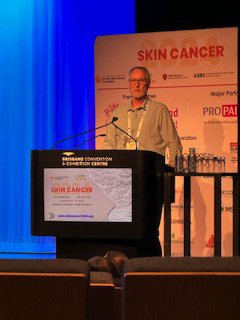
The promise of sun protection interventions relies on successfully disseminating them to new populations and settings with sufficient fidelity to be effective. Two methods for disseminating our evidence-based occupational sun protection intervention, Go Sun Smart at Work, were evaluated. One hundred thirty-eight (138) regional districts from 21 state Departments of Transportation throughout the United States were randomized to two scalability methods in a randomized pretest-posttest two-group design. The in-person scalability method included in-person visits to the workplaces to meet with managers and deliver training to employees. The digital scalability method utilized low-cost virtual communication with managers and video training for employees. At posttest, 255 managers reported their program implementation actions while 1387 employees reported receipt of sun safety training/communication and protection practices. Nearly all managers reported implementing training, communication, and sun protection actions, but implementation did not differ by scalability method. However, more employees reported sun protection training and communication from in-person than digital scalability method. Employee sun protection practices were unrelated to scalability method. Both scalability strategies motivated managers to implement sun safety training and communication, and more than other sun safety actions, possibly because training/communication fit into existing safety training processes and communication channels and required few resources. In-person training is preferred by many workers and technological barriers may have interfered with digital training delivery. Restrictions placed on the workplaces due to the COVID-19 pandemic interfered with scalability, possibly biasing the result towards the null. This research was funded by a grant from the National Cancer Institute (CA210259; David Buller, Principal Investigator).

Title: The Development of the GSSW SmartBot: A Virtual Guide for Occupational Sun Safety Implementation

Presenter: Mary Buller, MA

Authors: Mary Buller, MA; Barbara Walkosz, PhD; David Buller, PhD; Julia Berteletti, MSW; Brandon Herbeck, B; Irene Adjei, BS; Robert Martin; Steven Fullmer, BFA   
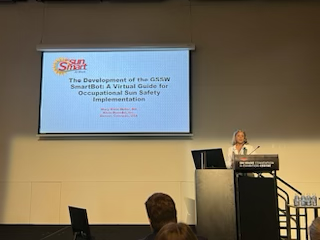
Outdoor workers are exposed to an extreme amount of solar ultraviolet radiation, making them highly vulnerable to skin cancer and heat illness. Increasing disparities in skin cancer survival and heat mortality in Black and Hispanic Americans, who are overrepresented in the outdoor workforce in the United States, highlight the need for inclusive and comprehensive sun safety education. Informed by systematic literature reviews and interviews with employees and managers, Go Sun Smart at Work (GSSW), an evidence-based skin cancer prevention program, was adapted to include enhanced messaging for people of color and to combine skin cancer and heat illness prevention. An online format was used, in response to the COVID-19 pandemic, to make sun safety implementation accessible, flexible, and simple for employers. A custom intelligent system, the SmartBot, guides employers (for example, safety managers) through three program components: policy, training, and implementation. It asks users questions about their organization and uses an enhanced version of the GravityForms survey engine to identify and tailor sun safety resources based on their responses. As users progress through the SmartBot, they collect resources from a library of sun safety content (Resource Hub). Built with the WordPress Content Management System, the Resource Hub includes informational videos, posters, fact sheets, a 45-minute training with quizzes, and sample safety policies. Users can return to their Resource Hub to retrieve resources or quickly search and filter all the resources in the system. The SmartBot’s impact on employee sun protection will be tested with 20 employers in a randomized field trial. This research was supported by a grant from the National Cancer Institute (CA257778; Mary Buller, Principal Investigator).

Title: Bills to Restrict Access to Indoor Tanning Facilities in U.S. State Legislatures, 1991-2023

Presenter: David Buller, PhD

Authors: David Buller, PhD; Julia Berteletti, MSW; Carolyn Heckman, PhD; Kevin Schroth, JD; Alan Geller, RN; Jerod Stapleton, PhD; Irene Adjei, BS; Anna Mitarotondo, BA; Samantha Guild, JD; Jeffrey Gershenwald, MD; Donna Regen, BA
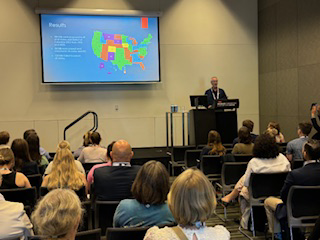
In the United States, indoor tanning facilities are regulated by state legislation and U.S. Food and Drug Administration. State laws with more stringent age restrictions are associated with less indoor tanning by youth. Legislative bills on indoor tanning introduced in states, the District of Columbia (DC), and Puerto Rico were collected and coded for age restrictions, parental involvement, warnings, operator requirements, and enforcement. Overall, 184 bills were introduced in 49 of 50 states and DC between 1991 and 2023, mostly after 2008. Overall, 56 bills were passed and enacted in 47 states and DC, and 126 bills failed. The first bill banning minors under age 18 from indoor tanning facilities was enacted in 2012, with an under-18 ban currently enacted in 22 states and DC. Age restrictions at other younger ages (14-17.5 years) were enacted in 10 other states. In many states, it took several years and proposed bills before a law was passed, with proposed bills typically becoming more stringent over time and enacted bills being more stringent than failed bills. However, warnings, operator requirements, and enforcement provisions were classified as weak in most bills. Association of political party of both bill sponsor and legislative majority with age restrictions and bill enactment were presented. Bills restricting indoor tanning facilities, including those restricting minors under age 18, have garnered support across the U.S. political spectrum. Findings can inform advocates and legislators on ways to increase stringency of indoor tanning laws that can contribute to decreasing rates of melanoma in young adults. This research was supported by a grant from the National Cancer Institute (CA244370; Carolyn Heckman and David Buller, Multiple Principal Investigators).

THE B-SMART APP: FINDINGS FROM AN IGNITION INTERLOCK STUDY

THE B-SMART APP: FINDINGS FROM AN IGNITION INTERLOCK STUDY

Driving while intoxicated (DWI) is a preventable source of morbidity and mortality in the United States. The Ignition Interlock Device (IID) requires a driver to blow into a breathalyzer installed in a vehicle to establish sobriety and reduces drunk driving while installed. IIDs have become widespread. Most U.S. states require DWI offenders to install IIDs in their cars. However, once IIDs are removed, DWI recidivism levels return to those similar to offenders who had no IID installed.

Klein Buendel Senior Scientist, Dr. W. Gill Woodall, presented DWI intervention study results at the 47th Annual Research Society on Alcohol Scientific Meeting on June 22-26 in Minneapolis, Minnesota. The purpose of this study was to develop and test an app (“B-SMART”) for DWI offenders and their Concerned Family Members (CFMs) to extend non-intoxicated driving beyond the IID installation period.

The B-SMART app has four modules: 1) Life with the Interlock – orientation to IIDs, 2) processes to support changes in drinking, 3) effective communication skills, and 4) family activities that don’t involve alcohol. Participants (pairs of DWI Offenders and CFMs N=76) were randomly assigned to receive the B-SMART web app (n=30) or access to an IID New Mexico Department of Transportation information page [Usual and Customary (UC) condition, n=46]. Data on failed IID tests and IID lockout events were obtained from Ignition Interlock providers and were the primary outcome variables.

IID data were collected at the end of the project period on 58% (n=71) of 123 participants, with one IID provider not providing IID data due to corporate policy restrictions. Two summary outcome variables were created: 1) the frequency of any failed test during IID installation period, and 2) IID lockout events, which occur when a driver repeatedly fails the breathalyzer test in a set time period. The mean number of failed IID tests was not significantly different for UC participants (n=45) than versus B-SMART participants (n=26). For lockout events, UC participants had significantly more lockout events than B-SMART participants.

Results indicate the B-SMART app reduced IID Lockout events, which is an important outcome as lower IID events predict reduced DWI recidivism. 

This research was supported by a grant from the National Institute on Alcohol Abuse and Alcoholism (AA022850; Dr. W. Gill Woodall, Principal Investigator). Collaborators on this conference presentation included Dr. Barbara McCrady and Dr. Vern Westerberg from the University of New Mexico; and Ms. Julia Berteletti, Ms. Marita Brooks, and Ms. Lila Martinez from Klein Buendel. The B-SMART app was developed by the Creative Team at Klein Buendel.

Just Care for Dementia in Prison

Just Care for Dementia in Prison

A research team from The Penn State University Ross and Carol Nese College of Nursing and Klein Buendel made two presentations related to formative research on the development of two training programs to care for chronically ill older people in prison at the 36th Annual Scientific Sessions of the Eastern Nursing Research Society April 4-5, 2024 in Boston, MA.

Title: Dementia Care Training Needs for Corrections Staff and Peer Caregivers

Dr. Susan Loeb, Penn State University

Presenter: Dr. Susan Loeb

The number of people living in prison with Alzheimer’s Disease and Related Dementias (ADRD) is growing. Care inequities for ADRD between prisons and community settings exist and warrant addressing. A standardized, evidence-based, feasible, and acceptable ADRD e-training program is needed to prepare corrections staff and peer caregivers for better managing and caring for people with ADRD in prisons. 

The purposes of this study were to (1) identify three priority learning needs of corrections staff and peer caregivers who manage and/or care for people living with ADRD in prisons; (2) identify a logo for the Just Care for Dementia training that was desirable to end-users; and (3) translate best practices from community-based ADRD care into evidence-based, accessible, and relevant ADRD content for prison settings. The end goal was to program prototypes for three highly interactive e-learning modules that fit within the restrictive context of corrections.

Focus group methodology guided potential future users in providing insights to ensure the content, design, and technology plans match the needs and constraints of prisons. Human subjects approvals were secured and participants’ signed informed consent was obtained. Settings were one men’s and one women’s state prison in the northeastern United States. Twelve corrections staff and 11 peer caregivers participated. Focus groups were audio recorded, transcribed, and deidentified.

Thematic analysis was completed independently by two researchers. The three priority content areas identified were fostering a safe and calm environment, addressing behavioral and psychological symptoms of dementia, and enhancing awareness of need. Participants identified two logo preferences. Advisory board consultation informed logo selection. Module content was developed via an iterative process to ensure contextual relevance of training, accessibility within the constraints of prisons, and the e-training matched identified training needs.

In summary, participants confirmed the need for ADRD training and indicated e-learning is a viable approach for addressing a pressing care need in prisons. 

This research was funded by an STTR grant to Klein Buendel from the National Institute on Aging (AG078103; Dr. Susan Loeb from Penn State and Dr. Barbara Walkosz from Klein Buendel, Multiple Principal Investigators). Collaborators included Dr. Erin Kitt-Lewis and Sherif Olanrewaju from Penn State University; and Amanda Brice and Steve Fullmer from Klein Buendel. 

Title: Small-Scale Usability Testing: E-learning modules for Peer Caregivers 

Presenter: Dr. Susan Loeb

Growing numbers of people will grow old and die while incarcerated. Research evidence supports using peer caregivers to assist staff with geriatric and end-of-life care. Peer caregivers training varies widely in content and duration. Evidenced-based, accessible, and contextually relevant materials are needed to effectively prepare peer caregivers. 

The purpose of this study was to conduct research and development for Just Care, a six-module e-learning program for peer caregivers and a single module to guide corrections staff in launching the program. Deputy Wardens identified people meeting our inclusion criteria. Nineteen people living in prison and 11 staff participated. Throughout usability testing, participants shared their thoughts aloud, while field notes were taken. Participants completed six open-ended questions, a demographic survey, and the System Usability Scale (SUS).

All users easily navigated through the program with minimal guidance. Many noted Just Care’s utility for future peer caregivers. Some users who were incarcerated had difficulty navigating the post-test assessments. A few staff users noted liking the additional resources available via links to PDFs. One staff user voiced concern about the safety of having incarcerated people help with care. Just Care received Round 1 SUS scores of 87.5 by users living in prison and 74.5 by staff. Following rapid refinement, Just Care received Round 2 mean SUS scores of 85.28 by users living in prison and 83.75 by staff. A SUS score of 68 is an above average score.

Overall, participants found Just Care innovative, useful, engaging, interactive, and relevant to providing geriatric and end-of-life care in prisons. Staff noted that Just Care raised awareness about the growing need for programming on geriatric care in prisons and that a peer caregiver program is a viable solution that is implementable by prison staff.  

This research was funded by an STTR grant to Klein Buendel from the National Institute on Aging (AG057239; Dr. Susan Loeb from Penn State and Dr. Barbara Walkosz from Klein Buendel, Multiple Principal Investigators). Collaborators included Dr. Erin Kitt-Lewis and Sherif Olanrewaju from Penn State University; and Brandon Herbeck, Peter Fu, and Steve Fullmer from Klein Buendel. 

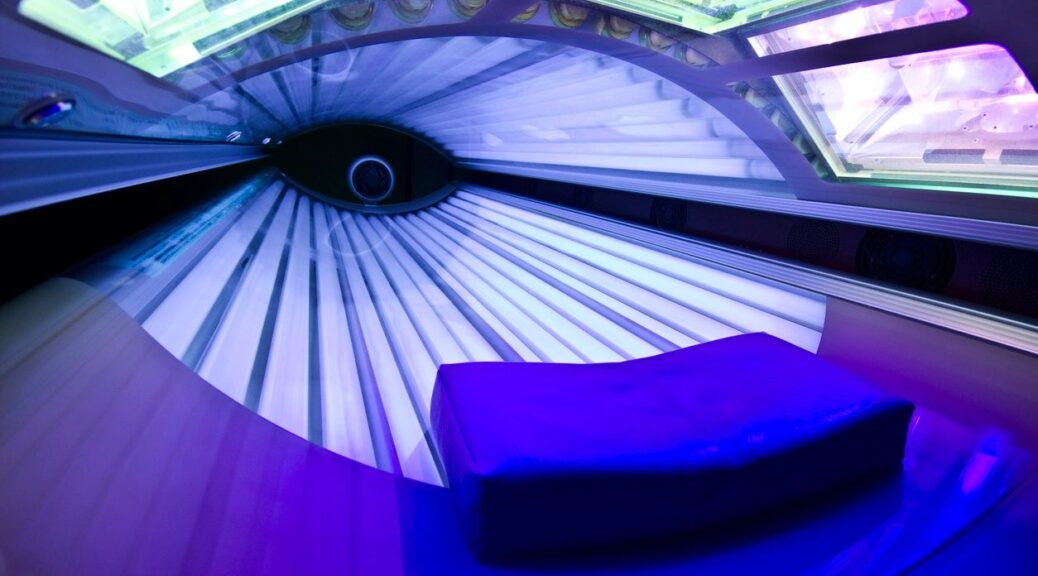
Indoor Tanning Policies Are Insufficient to Protect Young Adults

Indoor Tanning Policies Are Insufficient to Protect Young Adults

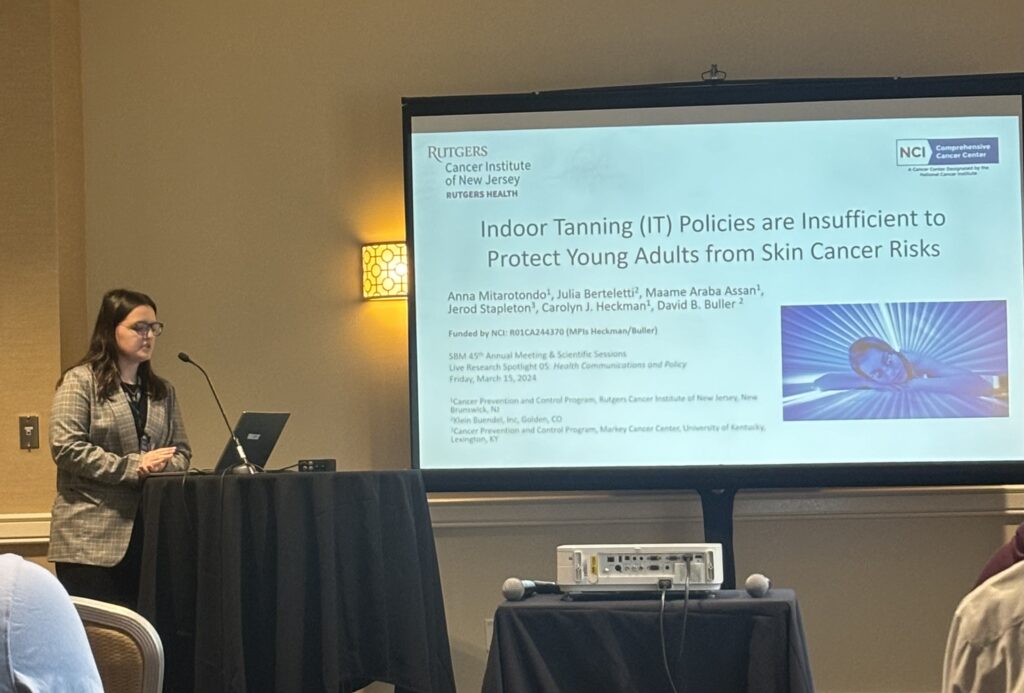
Ms. Anna Mitarotondo, a Research Program Manager from Rutgers University, gave a Research Spotlight presentation on the Indoor Tanning Policy research project at the 45th Annual Sessions and Meeting of the Society of Behavioral Medicine in Philadelphia, PA, March 13-16, 2024. Dr. Carolyn Heckman from Rutgers and Dr. David Buller from Klein Buendel are the project’s Multiple Principal Investigators.

Ms. Anna Mitarotondo, Rutgers University

Five million Americans are treated for skin cancer annually with the incidence of melanoma tripling in the last 40 years. Even a single session of indoor tanning is a well-established cause of melanoma especially at younger ages. Indoor tanning is also associated with sunburn, another major risk factor. In addition to FDA safety regulations, 46 states restrict minor indoor tanning access. More stringent laws (such as age bans vs. parental consent or no law) have been associated with less youth indoor tanning. However, enforcement and compliance are essential for successful law implementation. This study investigates regulation stringency, behavior, facility compliance, and sunburns.

The research team conducted an online, nationally representative survey of 1000 individuals aged 18-29 who indoor tanned in the last three years. 82% identified as female, and 74% as white, non-Hispanic. A majority (89%)  indoor tanned multiple times in the past three years. Participants reported being most likely to tan in indoor tanning salons, gyms, and beauty salons. They also reported indoor tanning in homes, spas, and apartment complexes, with participants indoor tanning in more types of facilities after age 18. Despite FDA recommendations, participants reported that only 16% of facilities prohibited daily or unlimited tanning. Nearly half (48%) of participants were not informed of time limits when indoor tanning. Half (50%) reported that over half of the time, they were able to avoid indoor tanning facility rules. Nearly two-thirds (61%) of participants reported burning from an indoor tanning device in the past three years, with 15% reporting a burn from their most recent session. Of participants who reported indoor tanning as minors, 61% reported burns and 30% reported getting medical attention.

This is the first study to show rates of indoor tanning at facilities other than tanning salons, both before and after age 18, in a representative national sample. Participants reported insufficient facility compliance with, and enforcement of, indoor tanning regulations, which in some cases may have led to severe burns. Analyses are underway to further investigate regulation stringency, enforcement, and compliance by type of facility and state, adjusting for demographic factors and additional key covariates. The goal is to inform future indoor tanning policies at the state and federal level.

This research was supported by a grant to Rutgers from the National Cancer Institute (CA244370; Dr. Carolyn Heckman and Dr. David Buller, Multiple Principal Investigators). Coauthors included and Ms. Maame Araba Assan from Rutgers University, Dr. Jerod Stapleton from the University of Kentucky, and Ms. Julia Berteletti from Klein Buendel.

Physical Activity, Motivation, and Social Media Content

Physical Activity, Motivation, and Social Media Content

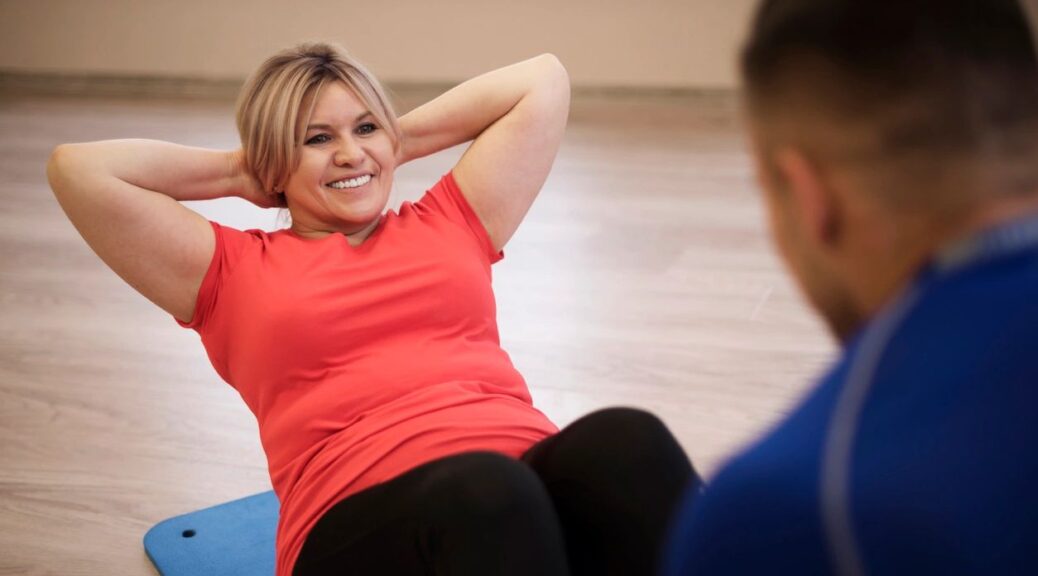
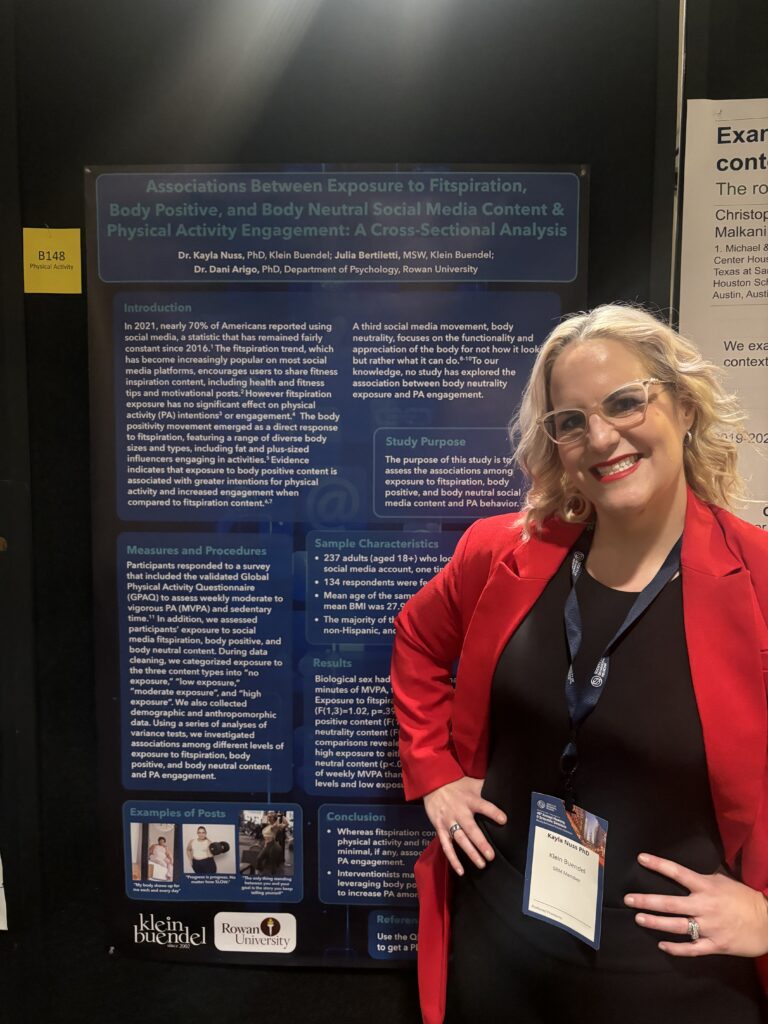
Klein Buendel Scientist, Dr. Kayla Nuss, and her collaborators presented two groundbreaking posters on physical activity and exposure to social media physical activity content at the 45th Annual Sessions and Meeting of the Society of Behavioral Medicine in Philadelphia, PA, March 13-16, 2024. The research delved into three types of physical activity content: fitspiration, body positivity, and body neutrality.

Title: Associations Between Exposure to Fitspiration, Body Positive, and Body Neutral Social Media Content and Physical Activity Engagement: A Cross-Sectional Analysis

Dr. Kayla Nuss

Presenter: Dr. Kayla Nuss

In 2021, nearly 70% of Americans reported using social media, a statistic that has remained fairly constant since 2016. The fitspiration trend, which has become increasingly popular on most social media platforms, encourages users to share fitness inspiration content, including health and fitness tips and motivational posts. However fitspiration exposure has no significant effect on physical activity (PA) intentions or engagement.1

The body positivity movement emerged as a direct response to fitspiration, featuring a range of diverse body sizes and types, including fat and plus-sized influencers engaging in activities. Evidence indicates that exposure to body positive content is associated with greater intentions for physical activity and increased engagement when compared to fitspiration content. A third social media movement, body neutrality, focuses on the functionality and appreciation of the body for not how it looks, but rather what it can do. To our knowledge, no study has explored the association between body neutrality exposure and PA engagement. As such, the purpose of this study is to assess the associations among exposure to fitspiration, body positive, and body neutral social media content and PA behavior.

Two-hundred and thirty-seven (237) participants responded to a survey that included the validated Global Physical Activity Questionnaire (GPAQ) to assess weekly moderate to vigorous PA (MVPA) and sedentary time. In addition, the authors assessed participants’ exposure to social media fitspiration, body positive, and body neutral content. During data cleaning, they categorized exposure to the three content types into “no exposure,” “low exposure,” “moderate exposure”, and “high exposure”. The authors also collected demographic and anthropomorphic data. Using a series of analyses of variance tests, they investigated associations among different levels of exposure to fitspiration, body positive, and body neutral content, and PA engagement. 

Biological sex had a significant main effect on weekly minutes of MVPA, and was included it in the models. Exposure to fitspiration had no significant effect, but exposure to both body positive content and body neutrality content did. Post-hoc comparisons revealed that in both contexts, participants who reported high exposure to either body positive or body neutral content had significantly more minutes of weekly MVPA than those who reported no exposure levels and low exposure levels, respectively.

The authors concluded that whereas fitspiration content is intended to inspire physical activity and fitness, there is no association between it and engagement. Interventionists may consider creating programs leveraging body positive or body neutral content to increase PA among social media users.

This research was sponsored by Klein Buendel and led by Dr. Kayla Nuss. Coauthors included Dr. Dani Arrigo from Rowan University and Ms. Julia Berteletti from Klein Buendel.

Title: Interaction Effects of Amotivation for Physical Activity and Fitness Social Media Exposure on Physical Activity Intentions

Presenter: Dr. Kayla Nuss

Nearly half of Americans seek fitness, physical activity (PA), and health advice from social media platforms like Facebook and Instagram. Further, nearly 20% have changed a component of their wellness regimen based on that advice. There are three main categories of physical and activity content on social media, each with its own content themes:

  • Fitspiration features mostly white, thin, Women, unengaged in PA and has no discernable association with motivation or PA engagement.1
  • Body positive content features diverse bodies, including fat and plus-sized influencers engaged in PA, and has been associated with greater intentions for PA. Associations with motivation and engagement are unknown.
  • Body neutrality is centered on the functionality of the body, rather than appearance.

To date, no study has examined its associations with PA motivation, intention, or engagement. The purpose of this study is to examine cross-sectional associations of exposure to fitness social media content with Self-Determination Theory motivational subtypes, and PA intention and engagement.

A total of 237 participants responded to a survey that included the validated Global Physical Activity Questionnaire (GPAQ) to assess weekly moderate to vigorous PA (MVPA). The authors examined intention for PA using the Behavioral Intentions Scale and assessed motivation for PA using the Behavioral Regulations in Exercise Scale. The authors also assessed participants’ exposure to social media fitspiration, body positive, and body neutral content. They categorized exposure to the three content types into “no exposure,” “low exposure,” “moderate exposure”, and “high exposure.” They also collected demographic and anthropomorphic data. Using a series of analyses of variance tests, the authors investigated associations among different levels of exposure to fitspiration, body positive, and body neutral content, and motivation, PA intention, and engagement.  

For the reporting of results, the authors first examined interaction effects between exposure to fitness content and each of the motivational subtypes on PA intention and behavior. They identified a significant interaction of amotivation (having no drive for the behavior) and exposure to both fitspiration and body positive content on PA intentions, but not engagement. Specifically, highly amotivated individuals who also reported high exposure to these social media types reported greater intentions for PA than those who reported moderate, low, or no exposure. There was no significant interaction effect between amotivation and body neutral exposure on PA intentions nor engagement.

The authors concluded that interventionists may consider exposing highly amotivated individuals to fitspiration or body positive social media to potentially increase intentions for PA. However, the intention-behavior gap must also be addressed in this population.

This research was sponsored by Klein Buendel and led by Dr. Kayla Nuss. Coauthors included Dr. Dani Arrigo from Rowan University and Ms. Julia Berteletti from Klein Buendel.

References

  1. Nuss K, Coulter R, Liu S. Content of social media fitspiration and its effect on physical activity-related behavior: A systematic review. Psychology of Popular Media. Published online 2023.