
Browsed by
Tag: Intervention

Project SHINE for Adolescent Tanning Prevention

Project SHINE for Adolescent Tanning Prevention

Dr. David Buller, Klein Buendel Director of Research, is a Co-Investigator on a new research project funded by the National Cancer Institute and being led by Dr. Yelena Wu, Principal Investigator, from the University of Utah. Project SHINE (Sun-safe Habits Intervention and Education) is a multi-modal intervention that targets adolescents’ views on the personal relevance of skin cancer and their ability to prevent the disease in order to increase their sun protection use and decrease their intentional tanning.

Project SHINE incorporates action plans, sun damage photographs, and education to teachers and parents in order to build on adolescents’ interest in novelty and need for highly personalized interventions. It also promotes environmental supports for adolescent skin cancer prevention. SHINE is novel in its application of the Extended Parallel Process Model, used in smoking and drug abuse interventions, to pediatric skin cancer prevention. The five-year study will be conducted with 30 high schools and over 10,000 students in 9th or 10th grade health classes. To support the rigor of this research, the project will objectively measure ultraviolet radiation (UVR) exposure among 10% of the sample who will wear a UVR monitoring device for 3-day periods after self-reported assessments.  

Dr. Buller is part of a well-established team that includes experts in skin cancer prevention, adolescent health behavior change, dermatology, school programs, and randomized trials. He will provide input on the design and implementation of the study, help develop parent/teacher education materials, and participate in results interpretation and manuscript preparation.

Skin cancer is a significant public health priority. It is the most commonly diagnosed form of cancer, afflicting more than 5 million people in the United States each year. Treatment costs total more than $8 billion each year. Skin cancer is highly preventable if individuals limit UVR exposure by using sun protection strategies, such as sunscreen, hats, protective clothing, and by avoiding tanning. Use of prevention strategies is critical during childhood and adolescence, when skin cells are particularly vulnerable to UVR damage leading to skin cancer. Due to their poor use of sun protection and likelihood to intentionally tan, adolescents, more than any other pediatric group, urgently need efficacious skin cancer preventive interventions. Schools offer the ideal setting to deliver skin cancer preventive interventions to large numbers of adolescents.

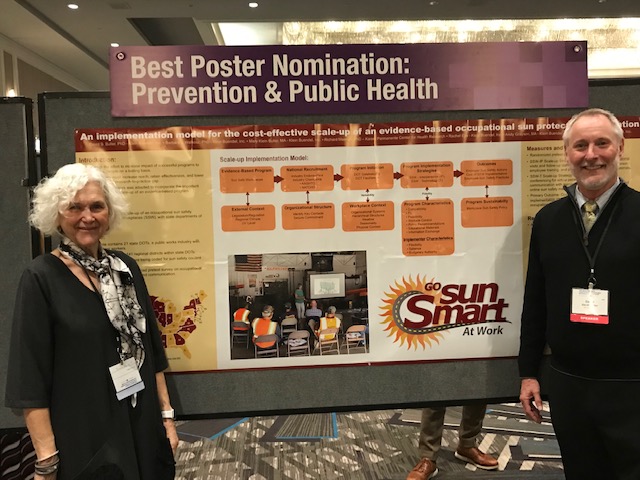
An Implementation Model for the Cost-effective Scale-up of the Sun Safe Workplaces Program

An Implementation Model for the Cost-effective Scale-up of the Sun Safe Workplaces Program

Dr. David Buller and Dr. Barbara Walkosz from Klein Buendel presented a poster on a new implementation model for the cost-effective scale-up of an occupational sun protection program at the 12th Annual Conference on the Science of Dissemination and Implementation in Health in Washington, DC, December 4-6, 2019. The poster was nominated for Best Poster from the Prevention and Public Health Division.

Scale-up is the effort to increase the impact of successful programs to benefit more people on a lasting basis. Scale-up efforts must increase reach, retain effectiveness, and lower costs to provide greater access to benefits and close the research-to-practice gap between effective programs and real-world application. This project is studying the nationwide scale-up of an occupational sun safety intervention, Sun Safe Workplaces, with state Departments of Transportation (DOTs), a public works sector with thousands of outdoor workers.

Costs of national distribution can be daunting and influence intervention intensity and program effectiveness. Identifying cost-effective scale-up strategies is essential for moving research into practice. The new framework draws upon existing implementation models, including those developed for occupational health and safety, and operationalizes implementation for scale-up within RE-AIM. The RE-AIM framework was adapted for this new framework by incorporating cost as a primary factor.

In a randomized trial, Sun Safe Workplaces (SSW) is assessing implementation rate and costs associated with two methods of scaling-up SSW. The original intervention depended on personal visits with managers, materials promoting sun protection policies and education, in-person sun safety training for employee groups, and on-going follow-up communication with managers supporting sun safety (SSW-IP), a resource-intensive form of intervention. Now SSW-IP is being contrasted to a scale-up strategy that uses web-based and telephone conferencing, responsive training platforms, and electronic resources for virtual contacts and training (SSW-T). Technology-based programs have the potential to deliver standardized, engaging content and increase portability while decreasing cost of delivery to enable reaching more employers when scaled-up to nationwide distribution. Districts within DOTs are randomized to one of the two scale-up methods. The SSW-IP and SSW-T interventions are being delivered in 21 state DOTs with 141 districts.

This research is funded by a grant from the National Cancer Institute (CA134705; Dr. David Buller and Dr. Barbara Walkosz, Multiple Principal Investigators). Additional poster coauthors include Dr. Richard Meenan from the Kaiser Permanente Center for Health Research; and Mary Buller, Rachel Eye, Andrew Grayson, and Savanna Olivas from Klein Buendel.

Preventing Alcohol and Drug Overuse Among Nightclub Patrons

Preventing Alcohol and Drug Overuse Among Nightclub Patrons

Nightclubs are high-risk settings for overuse of alcohol and other drugs. In a July publication in the Journal of Studies on Alcohol and Drugs, collaborators from the Pacific Institute for Research and Evaluation (PIRE), the University of California San Francisco, and Klein Buendel reported the outcomes of their intervention to protect nightclub patrons from substance abuse and harmful consequences.

Nightlife Safety Plans (NSP) is a group-based, tablet app-delivered intervention designed for groups of patrons arriving at nightclubs together. NSP encourages social groups to recognize early indicators of risk and take actions steps to de-escalate risky situations, such as physical and sexual aggression, through peer influence and other methods. The intervention was designed around a simple mnemonic – the three O’s: Outreach, Options, and Out:

  • Outreach: “provide outreach by approaching the friend and checking in, using nonconfrontational approaches”
  • Options: “provide options to a group member if a problem is identified”
  • Out: “know when the group should get out of the club to avoid further problems”

A total of 959 people from 352 social groups participated in the intervention at 41 different electronic music dance events at nightclubs in San Francisco, California. The measures (including breath samples for blood alcohol concentration and oral fluid samples for drug use), methods, analyses, results, discussion, and limitations are detailed in the publication.

In summary, intervening in the right place at the right time with peer influence strategies proved to be effective. The authors report that the NSP app appeared to increase protective actions to keep group members safe from overuse of alcohol and other drugs in these high-risk environments.

This research was funded by a grant to the Prevention Research Center at PIRE from the National Institute on Alcohol Abuse and Alcoholism (AA022331; Dr. Brenda Miller, Principal Investigator). Authors of the publication include Dr. Hilary Byrnes, Dr. Brenda Miller, Dr. Mark Johnson, and Veronica Rogers from PIRE; Dr. Beth Bourdeau from the University of California San Francisco; and Dr. David Buller and Julia Berteletti from Klein Buendel. The NSP tablet app was developed by Klein Buendel’s Creative Team.

STAC-T: A Bystander Bullying Intervention for Middle Schools

STAC-T: A Bystander Bullying Intervention for Middle Schools

Nationally, 20.8% of students age 12-18 report being bullied at school and 11.5% report being cyberbullied (1). Bullying peaks in middle school with 26% of students reporting being a target of bullying (1). Among middle schoolers, bullying victimization is associated with a variety of mental health problems including anxiety, depression, and suicide attempts. In addition, negative consequences linked with bullying extend to students who observe bullying (2). Student bystanders are also at increased risk for mental health problems, such as helplessness, isolation, and guilt. With 8 out of 10 students witnessing bullying (2), students need to know how to appropriately intervene.

The goal of Klein Buendel’s new Phase I STTR project is to begin to develop and test the feasibility of a middle school intervention to reduce bullying and its negative consequences. The project is being led by Dr. Aida Midgett (Principal Investigator) and Dr. Diana Doumas (Co-Investigator) of Boise State University, and Dr. Valerie Myers (Co-Investigator) of Klein Buendel.  The project is entitled “Translation of an In-Person Brief, Bystander Bullying Intervention (STAC) into a Technology-Based Program”.

Research has shown that bystanders can stop bullying by intervening (3, 4). Yet, most students do not intervene to defend targets because they do not know what to do (5). Comprehensive, school-wide bullying programs can be effective (6), but time- and labor-intensive resources required for program implementation pose significant barriers for schools, particularly in low-income and rural communities, which can reduce program uptake. To reduce these barriers, Dr. Midgett developed a brief bullying bystander intervention, using four strategies: “Stealing the show,” “Turning it over,” “Accompanying others,” and “Coaching compassion” (STAC) (7). STAC has been shown to be effective in reducing bullying perpetration (8,9) and victimization (8) and negative mental health consequences for bystanders who witness bullying (10-15).

Although brief interventions reduce implementation barriers, in-person programs still require training and delivery by school personnel, placing significant demands on schools. The product developed in this Phase I project is a technology-based, brief bystander bullying intervention (STAC-T) that can impact current bullying prevention approaches by: (a) significantly reducing implementation barriers for middle schools, particularly those in low-income and rural communities that can face educational, social, and health disparities; (b) training bystanders to effectively intervene, reducing bullying while simultaneously improving the mental health of bystanders; and (c) improving the program sustainability potential at the middle school level when bullying behavior typically reaches its peak.

This research project is funded by a grant from the National Institute on Minority Health and Health Disparities at the National Institutes of Health (MD014943; Dr. Aida Midgett, Principal Investigator).

References

  1. National Center for Education Statistics. Student Reports of Bullying: Results from the 2015 School Crime Supplement to the National Crime Victimization Survey. U.S. Department of Education;2016. NCES 2017-015.
  2. Rivers I, Poteat VP, Noret N, Ashurst N. Observing bullying at school: the mental health implications of witness status. Sch Psychol Q. 2009;24(4):211-223.
  3. Salmivalli C, Voeten M, Poskiparta E. Bystanders matter: associations between reinforcing, defending, and the frequency of bullying behavior in classrooms. J Clin Child Adolesc Psychol. 2011;40(5):668-676.
  4. Padgett S, Notar CE. Bystanders are the key to stopping bullying. Universal Journal of Educational Research. 2013;1(2):33-41.
  5. Hutchinson M. Exploring the impact of bullying on young bystanders. Educational Psychology in Practice. 2012;28(4):425-442.
  6. Gaffney H, Ttofi MM, Farrington DP. Evaluating the effectiveness of school-bullying prevention programs: an updated meta-analytical review [published online ahead of print July 20]. Aggr Violent Behav. 2018 doi: https://doi.org/10.1016/j.avb.2018.07.001
  7. Midgett A, Doumas D, Sears D, Lundquist A, Hausheer R. A bystander bullying psychoeducation program with middle school students: a preliminary report. Professional Counselor. 2015;5(4):486-500.
  8. Midgett A, Doumas DM, Johnston AD. Establishing school counselors as leaders in bullying curriculum delivery:Evaluation of a brief, school-wide bystander intervention. Professional School Counseling. 2017;21(1):1-9.
  9. Midgett A, Doumas DM, Trull R, Johnson J. Training students who occasionally bully to be peer advocates: is a bystander intervention effective in reducing bullying behavior? Journal of Child and Adolescent Counseling. 2017;3(1):1-13.
  10. Moran M, Midgett A, Doumas DM, Porchia S, Moody S. A mixed method evaluation of a culturally adapted, brief, bullying bystander intervention for middle school students. Under review
  11. Doumas DM, Midgett A, Watts AD. The impact of a brief, bullying bystander intervention on internalizing symptoms: Is gender a moderator of intervention effects? [published online ahead of print February 14]. Sch Psychol Int. 2019 doi: 10.1177/0143034319830149
  12. Watts A, Doumas DM, Midgett A. The efficacy of a brief, bystander bullying intervention on alcohol use among high school students. Journal of Addictions and Offender Counseling. In press
  13. Midgett A, Doumas DM. The impact of a brief, bullying bystander intervention on depressive symptoms. Journal of Counseling and Development. In press
  14. Midgett A, Doumas DM, Trull R. Evaluation of a bystander bullying intervention program for elementary school students. Professional School Counselor. 2018;20(1):172-183.
  15. Midgett A, Doumas DM, Trull R, Johnston A. A randomized controlled study evaluating a brief, bystander bullying intervention with junior high school students. Journal of School Counseling. 2017;15