Browsed by
Tag: Body neutrality

Collaborator Spotlight:
Ms. Anne Poirier

Collaborator Spotlight:
Ms. Anne Poirier

Ms. Poirier is the owner of a body neutrality coaching company and the author of books about self-care and compassion. She graduated from Plymouth State University with a bachelors’ degree in exercise science. She is also a graduate of the Eating Disorder Institute at Plymouth State University and the Life Coach Institute. She is an intuitive eating counselor, a self-talk trainer, and an NSCA-CSCS strength and conditioning specialist. She also serves on the National Eating Disorders Association Lived Experience Task Force.

Ms. Poirier is a nationally recognized body image expert and the author of The Body Joyful and Not a Fat Annie. She is a pioneer and leading voice for the body neutrality movement and has been featured and cited in major media outlets around the word including Shape, Women’s Health, New York Times, Washington Post, Newsy, Livestrong, ABC, and NPR. She is a long-time eating disorder survivor and certified self-talk trainer. She has been a guest on more than 50 podcasts. In 2015, she founded the company Shaping Perspectives…A Woman’s Way to Joy. The cornerstone of the company is the Body Joyful Solution, a coaching program based on the principles of body neutrality.

As her mission is to reduce bullying, body shaming, weight stigma, and eating disorders for the next generation, Ms. Poirier is collaborating with Klein Buendel Scientist, Dr. Kayla Nuss, on NoWeigh!, a novel approach to weight management. The NoWeigh approach emphasizes gratitude for the body’s function, a neutral attitude about the body’s appearance, and engagement in movement that is enjoyable, rather than weight loss. The NoWeigh! Project is funded by an SBIR grant from the National Institute of Diabetes, Digestive and Kidney Diseases (DK142209; Dr. Kayla Nuss, Principal Investigator).

No Weigh!

No Weigh!

Klein Buendel Scientist, Dr. Kayla Nuss, has launched a new research project, funded by the National Institute of Diabetes, Digestive and Kidney Diseases. It will test a novel approach to physical activity promotion. The proposed intervention, NoWeigh!, is a mobile app based on a framework called body neutrality. Body neutrality emphasizes gratitude for the body’s function, a neutral attitude about the body’s appearance, and engagement in movement that is enjoyable, rather than weight loss.

Obesity rates are on the rise in the United States. Weight loss has been the primary recommendation for managing comorbidities with obesity, such as elevated blood lipids and glucose, despite ample evidence that weight loss attempts generally lead to weight regain and weight cycling, which are associated with negative mental health outcomes like anxiety and depression. Experts have called for non-weight loss obesity management, by emphasizing health behaviors such as physical activity. An effective method to deliver physical activity interventions is via mobile apps, of which women are the most frequent users. However, most physical activity apps emphasize weight loss.

The goal of the new Phase I SBIR project is to demonstrate the technical merit and feasibility of developing a smartphone mobile app (NoWeigh!) to support physical activity engagement using the tenants of body neutrality and Self-Determination Theory as frameworks. Mobile health (mHealth) approaches using smartphones offer several advantages for dissemination and implementation of health interventions including that they are portable, typically “on,” readily available, affordable, and offer advanced functionality. In addition, ownership of smartphones among adults is high, enabling potentially vast reach and apps have been shown to improve uptake of, and adherence to, healthy lifestyle strategies.

Aim 1: Perform iterative focus groups in adult women (aged ≥18 years) from diverse backgrounds to collect potential-user information to identify barriers, needs and preferences for a body-neutrality physical activity app design.

Aim 2: Design the conceptual model and develop planned components of the NoWeigh! app which will include storyboards and clickable wireframes.

Aim 3: Conduct beta and usability testing on the clickable wireframes prototype of the NoWeigh! app to show feasibility, acceptability and potential for engagement, and finalize the app design.

Successful completion of Phase I SBIR research will provide evidence to support a larger Phase II project to program and test the full-scale NoWeigh! app in a randomized comparative effectiveness trial. The goal is to produce a commercially ready mobile app for physical activity promotion that does not center on weight loss, a cost-effective lifestyle intervention for decreasing disease risk and reducing healthcare costs. This mHealth approach is an ideal medium for physical activity promotion because the reach, portability, and advanced functionality of mHealth devices allows for effective use by a broad range of adult women.

This grant was awarded to Klein Buendel by the National Institute of Diabetes, Digestive and Kidney Diseases (DK142209; Dr. Kayla Nuss, Principal Investigator). Dr. Nuss’ research collaborator on this project is Anne Poirier. She is the owner of a body neutrality coaching company and the author of the book, The Body Joyful, a guide to a life based on self-care and compassion. The NoWeigh! app will be designed and programmed by the Creative Team at Klein Buendel.

Content Analysis of Posts Featuring Popular Instagram Fitness and Exercise Trends

Content Analysis of Posts Featuring Popular Instagram Fitness and Exercise Trends

Dr. Kayla Nuss, Klein Buendel Scientist, and her co-authors have published new data on the content of Instagram posts pertaining to exercise in the journal, Psychology of Popular Media. The paper is entitled, “What’s in a Hashtag? A Comparative Content Analysis of Fitspiration, Body Positivity, and Body Neutrality Posts on Instagram.”

The research team conducted a comparative analysis of 200 Instagram posts from three categories: fitspiration, body positivity, and body neutrality. There were 605 total posts. All content types featured mostly White women, although fitspiration featured slightly more racial diversity. Most people featured in fitspiration and body positivity posts were thin whereas the majority of those in body neutrality posts were of average body size. Commercialization was the most prominent message in all three content types and weight loss was featured often in both fitspiration and body positivity posts.

Based on these results, the authors conclude that body positivity has seemingly drifted away from its original intention and body neutrality now seems aligned with the origins of body positivity. Full descriptions of the study design, methods, results, and limitations are provided in the Psychology of Popular Media publication. In the paper, the authors offer recommendations for researchers to develop social media health behavior interventions using elements of these popular content types.

This research was sponsored by Klein Buendel and led by Dr. Kayla Nuss. Her collaborators included Julia Berteletti, Dr. Barbara Walkosz, Irene Adjei, Annelise Small, Liliana Salcido Beltran, and Noah Chirico from Klein Buendel; Anne Poirier from Shaping Perspectives in South Carolina; and Dr. Danielle Arigo from Rowan University in New Jersey.

Physical Activity, Motivation, and Social Media Content

Physical Activity, Motivation, and Social Media Content

Klein Buendel Scientist, Dr. Kayla Nuss, and her collaborators presented two groundbreaking posters on physical activity and exposure to social media physical activity content at the 45th Annual Sessions and Meeting of the Society of Behavioral Medicine in Philadelphia, PA, March 13-16, 2024. The research delved into three types of physical activity content: fitspiration, body positivity, and body neutrality.

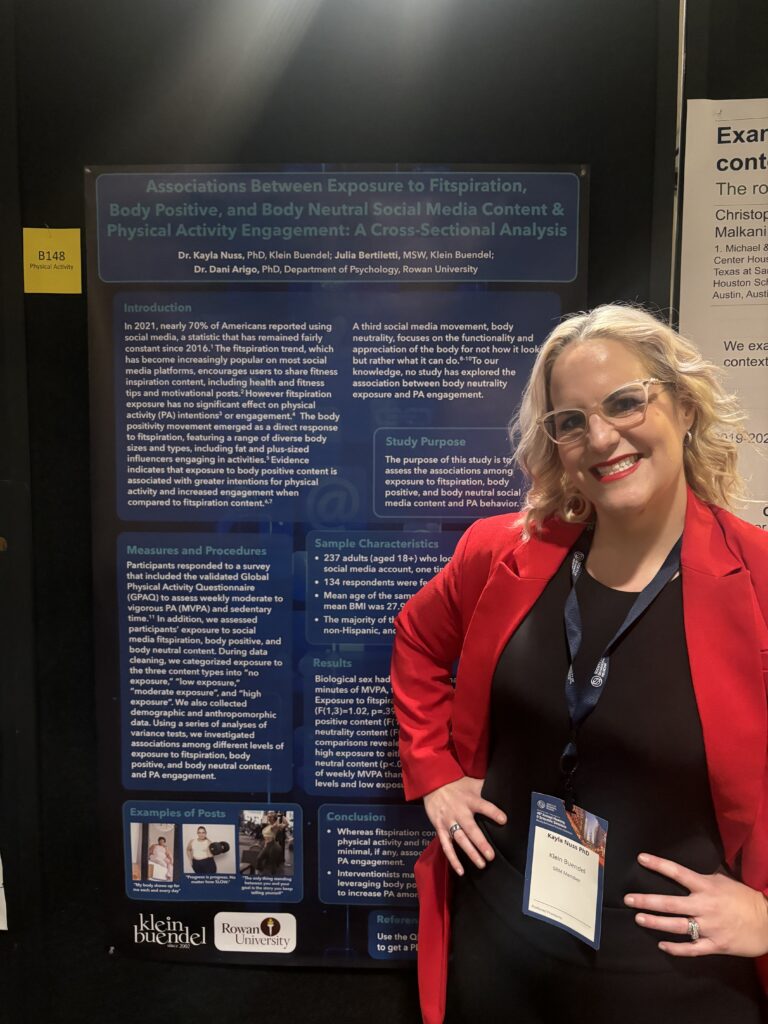
Title: Associations Between Exposure to Fitspiration, Body Positive, and Body Neutral Social Media Content and Physical Activity Engagement: A Cross-Sectional Analysis

Dr. Kayla Nuss

Presenter: Dr. Kayla Nuss

In 2021, nearly 70% of Americans reported using social media, a statistic that has remained fairly constant since 2016. The fitspiration trend, which has become increasingly popular on most social media platforms, encourages users to share fitness inspiration content, including health and fitness tips and motivational posts. However fitspiration exposure has no significant effect on physical activity (PA) intentions or engagement.1

The body positivity movement emerged as a direct response to fitspiration, featuring a range of diverse body sizes and types, including fat and plus-sized influencers engaging in activities. Evidence indicates that exposure to body positive content is associated with greater intentions for physical activity and increased engagement when compared to fitspiration content. A third social media movement, body neutrality, focuses on the functionality and appreciation of the body for not how it looks, but rather what it can do. To our knowledge, no study has explored the association between body neutrality exposure and PA engagement. As such, the purpose of this study is to assess the associations among exposure to fitspiration, body positive, and body neutral social media content and PA behavior.

Two-hundred and thirty-seven (237) participants responded to a survey that included the validated Global Physical Activity Questionnaire (GPAQ) to assess weekly moderate to vigorous PA (MVPA) and sedentary time. In addition, the authors assessed participants’ exposure to social media fitspiration, body positive, and body neutral content. During data cleaning, they categorized exposure to the three content types into “no exposure,” “low exposure,” “moderate exposure”, and “high exposure”. The authors also collected demographic and anthropomorphic data. Using a series of analyses of variance tests, they investigated associations among different levels of exposure to fitspiration, body positive, and body neutral content, and PA engagement. 

Biological sex had a significant main effect on weekly minutes of MVPA, and was included it in the models. Exposure to fitspiration had no significant effect, but exposure to both body positive content and body neutrality content did. Post-hoc comparisons revealed that in both contexts, participants who reported high exposure to either body positive or body neutral content had significantly more minutes of weekly MVPA than those who reported no exposure levels and low exposure levels, respectively.

The authors concluded that whereas fitspiration content is intended to inspire physical activity and fitness, there is no association between it and engagement. Interventionists may consider creating programs leveraging body positive or body neutral content to increase PA among social media users.

This research was sponsored by Klein Buendel and led by Dr. Kayla Nuss. Coauthors included Dr. Dani Arrigo from Rowan University and Ms. Julia Berteletti from Klein Buendel.

Title: Interaction Effects of Amotivation for Physical Activity and Fitness Social Media Exposure on Physical Activity Intentions

Presenter: Dr. Kayla Nuss

Nearly half of Americans seek fitness, physical activity (PA), and health advice from social media platforms like Facebook and Instagram. Further, nearly 20% have changed a component of their wellness regimen based on that advice. There are three main categories of physical and activity content on social media, each with its own content themes:

  • Fitspiration features mostly white, thin, Women, unengaged in PA and has no discernable association with motivation or PA engagement.1
  • Body positive content features diverse bodies, including fat and plus-sized influencers engaged in PA, and has been associated with greater intentions for PA. Associations with motivation and engagement are unknown.
  • Body neutrality is centered on the functionality of the body, rather than appearance.

To date, no study has examined its associations with PA motivation, intention, or engagement. The purpose of this study is to examine cross-sectional associations of exposure to fitness social media content with Self-Determination Theory motivational subtypes, and PA intention and engagement.

A total of 237 participants responded to a survey that included the validated Global Physical Activity Questionnaire (GPAQ) to assess weekly moderate to vigorous PA (MVPA). The authors examined intention for PA using the Behavioral Intentions Scale and assessed motivation for PA using the Behavioral Regulations in Exercise Scale. The authors also assessed participants’ exposure to social media fitspiration, body positive, and body neutral content. They categorized exposure to the three content types into “no exposure,” “low exposure,” “moderate exposure”, and “high exposure.” They also collected demographic and anthropomorphic data. Using a series of analyses of variance tests, the authors investigated associations among different levels of exposure to fitspiration, body positive, and body neutral content, and motivation, PA intention, and engagement.  

For the reporting of results, the authors first examined interaction effects between exposure to fitness content and each of the motivational subtypes on PA intention and behavior. They identified a significant interaction of amotivation (having no drive for the behavior) and exposure to both fitspiration and body positive content on PA intentions, but not engagement. Specifically, highly amotivated individuals who also reported high exposure to these social media types reported greater intentions for PA than those who reported moderate, low, or no exposure. There was no significant interaction effect between amotivation and body neutral exposure on PA intentions nor engagement.

The authors concluded that interventionists may consider exposing highly amotivated individuals to fitspiration or body positive social media to potentially increase intentions for PA. However, the intention-behavior gap must also be addressed in this population.

This research was sponsored by Klein Buendel and led by Dr. Kayla Nuss. Coauthors included Dr. Dani Arrigo from Rowan University and Ms. Julia Berteletti from Klein Buendel.

References

  1. Nuss K, Coulter R, Liu S. Content of social media fitspiration and its effect on physical activity-related behavior: A systematic review. Psychology of Popular Media. Published online 2023.