
Browsed by
Month: April 2026

KB Research Presented at SBM

KB Research Presented at SBM

*Klein Buendel authors are bolded.

Title: Applying Body Neutrality Principles to Physical Activity Promotion: A Pilot Test of the Body Neutrality Playbook 

Presenter: Dr. Kayla Nuss 

Collaborators: Anne Poirier, Amanda Brice, Sierra Held, Taylor Sullivan, Noah Chirico

This pilot study examined preliminary effects of the Body Neutrality Playbook on physical activity behavior, Self-determination Theory (SDT) motivation, and body image–related constructs in women insufficiently active at baseline. 

Body image concerns and weight stigma can undermine motivation for physical activity, particularly among women not meeting public health recommendations. The Body Neutrality Playbook is a six-week, self-guided workbook grounded in body neutrality principles, designed to promote sustainable physical activity by fostering autonomous motivation, self-compassion, and body appreciation while reducing harmful appearance-based cognitions. 

Twenty adult women completed the Body Neutrality Playbook over six weeks. Measures were collected at baseline and post-intervention, including self-reported weekly minutes of moderate-to-vigorous physical activity (MVPA), physical activity intention, physical activity planning, SDT-based motivation (intrinsic, integrated, identified, introjected, external), basic psychological needs satisfaction (competence, autonomy, relatedness), body functionality appreciation, body compassion (body kindness, motivated action, common humanity), internalized weight bias, and physical appearance comparison. Analyses examined mean change scores and Cohen’s d effect sizes to assess preliminary intervention impact. 

Post-intervention, participants demonstrated meaningful increases in MVPA minutes per week, physical activity intention, and physical activity planning. SDT outcomes showed increased competence and autonomy, decreased introjected regulation, and increased integrated regulation and intrinsic motivation. Body image–related outcomes indicated increases in body appreciation, decreases in physical appearance comparison, and improvements in two of three body compassion subscales (body kindness and motivated action). Effect sizes for these changes were in the small-to-large range, suggesting practical significance despite the small sample. 

Preliminary findings suggest the Body Neutrality Playbook may promote both autonomous physical activity motivation and positive body image while reducing appearance-based self-comparisons among women who are insufficiently active. The combination of body neutrality principles and SDT-informed behavior change strategies may address both psychological and behavioral barriers to physical activity. Future research with larger, more diverse samples and a controlled design is warranted to evaluate efficacy and mechanisms of change. 

This research was sponsored by Klein Buendel and led by Dr. Kayla Nuss. Anne Poirier is from Shaping Perspectives.

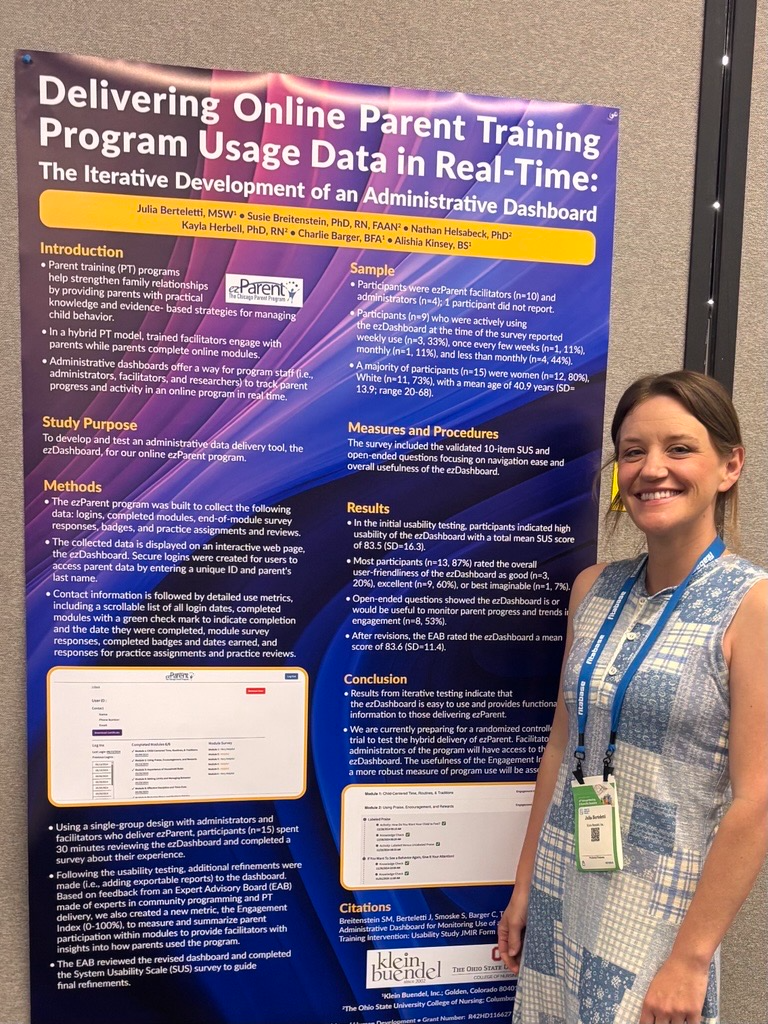
Title: Delivering online parent training program usage data in real-time: the iterative development of an administrative dashboard  

Presenter: Julia Berteletti 

Collaborators: Dr. Susie Breitenstein, Dr. Nathan Helsabeck, Dr. Kayla Herbell, Charlie Barger, Alishia Kinsey 
Julia Berteletti

Online parent training programs help strengthen parent-child relationships by providing parents with practical knowledge and evidence-based strategies for managing child behavior. In a hybrid parent training model, facilitators engage with parents while parents complete online modules. Administrative dashboards offer an integrated platform for program staff (administrators, facilitators, researchers) to track parent progress and activity in online parent training modules in real time. 

The research team iteratively developed and tested an administrative data delivery dashboard of the online ezParent Parent Training program. Using a single-group design with administrators and facilitators who deliver ezParent, 15 participants spent 30 minutes reviewing the ezDashboard and completed a survey about their experience. The survey included the validated 10-item System Usability Scale (SUS) and open-ended questions focusing on navigation ease and overall usefulness of the ezDashboard. Following the usability testing, we made additional refinements (adding exportable reports) to the dashboard. Based on feedback from an Expert Advisory Board (EAB) made of experts in community programming and parent training delivery, we also created a new metric, the Engagement Index, to measure and summarize parent participation within modules to provide facilitators with insights into how parents used the program. The EAB reviewed the revised dashboard and completed the SUS survey. Final refinements have been completed. 

In the initial usability testing, participants indicated high usability of the ezDashboard with a total mean SUS score of 83.5. Most participants (n=13, 87%) rated the overall user-friendliness of the ezDashboard as good (n=3, 20%), excellent (n=9, 60%), or best imaginable (n=1, 7%).  Open-ended questions showed the ezDashboard is or would be useful to monitor parent progress and trends in engagement (n=8, 53%). To facilitate that, we created the Engagement Index (0-100% per module) to assist facilitators’ understanding of how parents interact with ezParent. After revisions, the EAB rated the ezDashboard as 83.6. 

Results from iterative testing indicate that the ezDashboard is easy to use and provides functional information to those delivering ezParent.  Next, the ezDashboard will be used in a randomized controlled trial testing hybrid delivery of ezParent. The usefulness of the Engagement Index as a more robust measure of program use will be assessed.  

This STTR grant was awarded to Klein Buendel by the Eunice Kennedy Shriver National Institute of Child Health and Human Development (HD116627; Dr. Susan Breitenstein, Principal Investigator from Ohio State University). Research collaborators include Julia Berteletti from Klein Buendel, and Dr. Amie Bettencourt and Dr. Deborah Gross from Johns Hopkins University.

The ezParent technology was designed and programmed by the Creative Team at Klein Buendel. 

Cancer Prevention Research Presented at ASPO

Cancer Prevention Research Presented at ASPO

Klein Buendel investigators and their collaborators presented research from two large studies at the 50th Annual Meeting of the American Society of Preventive Oncology on April 12-14 in Denver, Colorado. The theme of the conference was “50 Years of Impact: Empowering Communities Through Cancer Prevention Research.” 

*Klein Buendel authors are bolded.

Title: A Confederate Study of Indoor Tanning Facility Compliance with Laws

Presenter: Dr. Carolyn Heckman

Co-authors: Anna Mitarotondo, Melissa Goldstein, Rucha Janodia, Ileana Gonzalez, Dr. David Buller, Julia Berteletti

  • This submission was designated as a Best of ASPO Abstract.

Trained and supervised pseudo-patrons called randomly selected indoor tanning facilities (indoor tanning salons, beauty salons/spas, gyms, apartment buildings) in 50 states and DC, posing as minors one year younger than the state’s permitted age to indoor tan (age 17 in states banning indoor tanning under 18) or age 16 in states with no age restriction. Using a semi-structured script, pseudo-patrons asked about scheduling an indoor tanning session, unlimited indoor tanning (contrary to FDA guidelines), risk of skin burns, and parental involvement requirements. Responses were coded, with discrepancies resolved by consensus, and summarized descriptively.

A total of 504 calls were completed to 206 indoor tanning salons, 111 gyms, 101 spas/beauty salons, and 86 apartment buildings. Overall, 55% of facilities would allow pseudo-patrons to book an appointment or “walk in” for indoor tanning, despite being underage, compared to 32% in states with under-18 bans. In states with minor restrictions, indoor tanning salons were least likely (48%) to permit minor indoor tanning and gyms, most likely to do so (56%). Twenty-six percent (26%) of staff did not ask pseudo-patrons their age, irrespective of law type. Forty-four percent (44%) of gyms/apartments did not require membership/tenancy to indoor tan. Most facilities (92%) offered unlimited indoor tanning packages or unlimited access to tanning beds when open. Only 52% of facility staff acknowledged that pseudo-patrons’ skin could be burned, when asked.

Although many states have laws restricting indoor tanning by minors, indoor tanning facilities were commonly non-compliant with age restrictions, suggesting inadequate law awareness and/or enforcement. Strategies must be identified to implement indoor tanning laws effectively and realize their benefits, including preventing skin burns, skin cancer, and other health consequences. Ongoing analyses are evaluating compliance when scheduling appointments online and by additional law provisions, state demographics, and U.S. region.

This research was supported by a grant to Rutgers University from the National Cancer Institute (CA244370; Dr. Carolyn Heckman and Dr. David Buller, Multiple Principal Investigators).

Title: Correlates of Human Papillomavirus Vaccination Among a Sample of Emerging Adults Aged 18-26 Living in Rural Locations in the Western United States

Presenter: Dr. David Buller

Co-authors:  Dr. Deanna Kepka, Dr. Echo Warner, Dr. Evelinn Borrayo, Dr. Andrew Sussman, Alishia Kinsey, Dr. W. Gill Woodall, Dr. David Buller

Dr. Borrayo, Dr. Buller and Dr. Warner

Human Papillomavirus (HPV) vaccination status and correlates were examined in a sample of emerging adults living in rural locations in the western United States. Eight hundred and ten (n=810) emerging adults residing in rural areas in 17 western U.S. states were recruited from online survey panels or by social media advertising from August 2024-2025 for a randomized trial. Emerging adults reported at baseline their HPV vaccine uptake status, including number of doses received. Using logistic regression analysis, we tested the association of demographics, attitudes, health care, and social media use with HPV vaccine uptake status (0=no/don’t know; 1=vaccinated) and vaccine doses received (0=0 or 1 dose/don’t know; 1=2 or 3 doses).

Overall, 424 (52.3%) rural emerging adults reported being vaccinated for HPV and 184 (22.7%) not being vaccinated, and 202 (24.9%) did not know. Of the 424 emerging adults vaccinated, 41 emerging adults (9.7%) recalled receiving one dose, 88 (20.7%) two doses, and 101 (23.8%) three doses of the vaccine, but 194 emerging adults (45.8%) did not know. More rural emerging adults who were vaccinated were female, more educated, attended religious services less frequently, had a personal/family history of cancer, were more confident vaccines are safe, and had less constraints on getting vaccinated. More rural emerging adults with multiple vaccine doses were older, female, visited a physician for a routine health check-up more recently, were more confident that vaccines are safe, and had less constraints on getting vaccinated.

Uptake of HPV vaccination among rural emerging adults (52.3%) was slightly higher than the national rate in the 2022 National Health Interview Survey (47.4%). Emerging adults need advice on how to confirm vaccination status (such as checking with parent, physician, or vaccine registry) when promoting catch-up HPV vaccination. HPV vaccination interventions should educate on vaccine safety/ constraints, how it can reduce personal/family cancer concerns, and religious groups that support it. Medical providers should offer HPV vaccination to emerging adults during routine health check-ups. Male and less educated emerging adults would benefit from intervention.

This research from the #4Corners4Health study was supported by a grant to Klein Buendel from the National Cancer Institute (CA268037; Dr. David Buller and Dr. Andrew Sussman, Multiple Principal Investigators). Other collaborators are from the University of Arizona, the University of Colorado, the University of Utah, and Colorado State University.

Title: Associations Between Food Insecurity and Dietary Intake and Nicotine Use Among Rural Emerging Adults in the Western United States

Presenter: Dr. Megan Skiba

Co-authors:  Dr. Doug Taren, Dr. Dolores Guest, Dr. Kim Henry, Dr. Judith Gordon, Noah Chirico, Dr. Echo Warner, Alishia Kinsey, Angela Jung, Dr. Andrew Sussman, Dr. David Buller

Dr. Skiba

The purpose of the study was to evaluate the associations between food insecurity, dietary intake, and tobacco/nicotine use among emerging adults aged 18-26 years living in rural areas of the western United States. 

This analysis used baseline data from 810 rural emerging adults participating in a randomized trial evaluating a social media-delivered cancer prevention intervention. Emerging adults completed self-report surveys assessing demographics, dietary intake (NCI Dietary Screener Questionnaire), and any nicotine product use (yes/no) in the past 30 days. Dietary measures included predicted intake of fruit and vegetable (servings/day), fiber (g/day), added sugar from sugar sweetened beverages (tsp/day), and red/processed meat (frequency/week). Food insecurity was categorized as very low food secure, low food secure, and high food secure from a single item measuring worry about running out of food before having money to buy more. Associations between food insecurity and dietary intake or tobacco/nicotine use were examined using linear or logistic regression models, adjusting for significant demographic covariates. Linear trend tests assessed graded relationships across food insecurity levels.

Of emerging adults (mean age 22.7 years), 62% reported low or very low food security. Food insecurity was associated with race, sex, education, and employment and were used as model covariates. A positive linear trend was observed between food insecurity and added sugar from sugar sweetened beverages, with very low food secure emerging adults consuming an average of 13.0 tsp/day from sugar sweetened beverages. There were no significant associations between food insecurity and fruit and vegetable, fiber, or red/processed meat intake, although fruit and vegetable and fiber intake were low overall (2.3 ± 0.6 servings/day and 15.1 ± 3.4 g/day, respectively). Percent of emerging adults using nicotine was greater with increasing levels of food insecurity: 24% among those with high food security, 41% among those with low food security, and 53% among those with very low food security. Odds increased 2.5 times for each stepwise increase in food insecurity.

Experiencing food insecurity may be a determinant of cancer-preventive health behaviors in rural emerging adults. Very low food security may be an important target for interventions aimed at improving multiple cancer preventive health behaviors among rural emerging adults.

This research from the #4Corners4Health study was supported by a grant to Klein Buendel from the National Cancer Institute (CA268037; Dr. David Buller and Dr. Andrew Sussman, Multiple Principal Investigators). Other collaborators are from the University of Arizona, the University of Colorado, the University of Utah, and Colorado State University.