Browsed by
Tag: Minors

Helps and hindrances to passing state indoor tanning laws

Helps and hindrances to passing state indoor tanning laws

Indoor tanning causes skin cancers, including potentially deadly melanoma. Indoor tanning often starts during youth, a critical time for deleterious skin damage. About half of U.S. states have enacted laws banning indoor tanning for minors under the age of 18. A multi-institutional team of researchers including Dr. David Buller and Julia Berteletti from Klein Buendel has published a paper in Translational Behavioral Medicine that reports qualitative findings from interviews with key informants involved in indoor tanning legislative efforts to identify/describe factors influencing law enactment, based on the Multiple Streams Framework (1).

Guided by expert advisors and using snowball-sampling, 64 key informants from 16 states with most recently enacted indoor tanning laws regulating minor access and states without restrictions were contacted. In virtual interviews, key informants shared their unique “story” of indoor tanning bill efforts, enactment, implementation, impact, and potential future directions, which were transcribed and qualitatively coded by trained staff.

Although key informant roles (legislators, advocates, clinicians, and melanoma survivors) and legislative processes vary by state, similar facilitators and barriers to indoor tanning bill passage were identified: personal stories, advocacy, opposition, preparation, legislator education, economic/ enforcement issues, bill stringency, political values/partisanship, and legislative process. Other factors influencing bill enaction included failed U.S. Food and Drug Administration attempts toward federally banning minor indoor tanning and competing priorities.

Despite evidence of laws’ impact on minors’ indoor tanning, policy enaction is challenging and slow. Understanding key facilitators and barriers may help advocates to advance legislation efforts. Advocating for stringent laws necessitates consideration of potential downstream effects. For example, even with policy enactment, key informants believed enforcement and compliance were likely insufficient and variable, with minors continuing to indoor tan, putting them at risk for potentially deadly skin cancer.

This research was supported by a grant to Rutgers University from the National Cancer Institute (CA244370; Dr. Carolyn Heckman and Dr. David Buller, Multiple Principal Investigators). Authors include Dr. Carolyn Heckman, Ms. Anna Mitarotondo, Mr. Kevin Schroth, and Dr. Shawna Hudson from Rutgers University; Dr. Jerod Stapleton from the University of Kentucky; Dr. Robert Dellavalle from the University of Minnesota; Dr. Sophie Balk from the Albert Einstein College of Medicine; and Dr. David Buller and Ms. Julia Berteletti from Klein Buendel.

References

  1. Kingdon JW. Agendas, Alternatives, and Public Policies. Longman, 2003.
Stringency of State Indoor Tanning Laws

Stringency of State Indoor Tanning Laws

Approximately five million cases of skin cancer are diagnosed among Americans at a cost nearing $9 billion annually. Indoor tanning (IT) is a risk factor for skin cancer. Restricting IT facilities, especially access by minors, has been the subject of state laws. More stringent restrictions on youth access (for example, bans by age vs. parental consent laws) appear to be associated with reduced IT by youth.

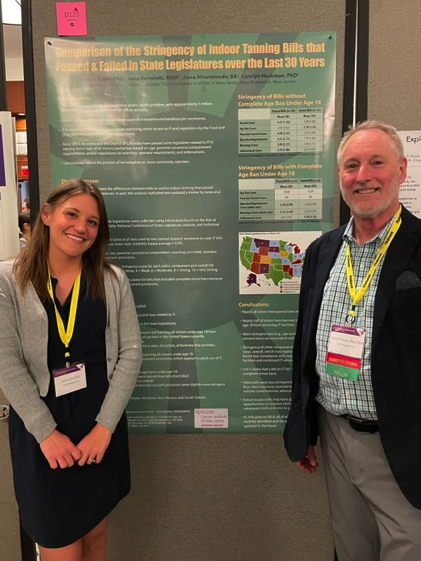
Julia Berteletti and David Buller at SBM

A team led by Dr. Carolyn Heckman from Rutgers University and Dr. David Buller from Klein presented a poster characterizing the IT policy landscape of U.S. states at the 44th Annual Sessions and Meeting of the Society of Behavioral Medicine in Phoenix, Arizona on April 26-29, 2023. The poster was entitled “Comparison of the stringency of indoor tanning bills regarding minors that passed and failed in state legislatures over the last 30 years.”

The research team coded 107 state IT law documents and compared passed laws to failed bills (proposed but not voted on or proposed but voted down), using a validated coding tool that assessed the presence of age bans, parental consent/accompaniment, warnings, operator requirements, and enforcement. Component codes were scaled on 10-point stringency measures (0=no regulation, 10=very strong regulation). Component and total summed scores were calculated, with higher scores indicating more stringent IT restrictions.

Between 1991 and 2022, 46 states and the District of Columbia passed a law on IT, with 23 banning access to IT facilities by minors under age 18. By contrast, 60 bills on IT failed to pass in 31 states since 2008. However, stringency of laws is weak, overall, which may explain why recent research found low compliance of IT facilities with regulations and continued IT among minors. Failed bills without minor bans were less stringent than similar passed laws, on nearly all components. Failure may have presented advocates opportunities to improve stringency of subsequent bills and time to garner more support for IT restrictions. In fact, less stringent bills may have failed because they had less support from outside constituencies (for example, medical societies and public health advocates) and among legislators. To gain insight into this public health legislation process, we are interviewing key informants from states with recent policy activity.

This research was supported by a grant to Rutgers University from the National Cancer Institute (CA244370; Dr. Carolyn Heckman and Dr. David Buller, Multiple Principal Investigators). Co-authors included Ms. Julia Berteletti from Klein Buendel and Ms. Anna Mitarotondo from Rutgers University.

Implementation and Effectiveness of an Online Responsible Vendor Training Program for Recreational Marijuana Stores

Implementation and Effectiveness of an Online Responsible Vendor Training Program for Recreational Marijuana Stores

Since 2012, nine U.S. States and the District of Columbia (DC) have legalized recreational marijuana, and several other states are looking to follow suit in coming years. At the outset of the legalization of recreational marijuana, the U.S. Department of Justice (DOJ) informed these states that they must put robust constraints into place that prevent youth access to marijuana. To accomplish this DOJ objective, Dr. David Buller and Dr. Gill Woodall from Klein Buendel (KB), and their co-authors created Train To Tend, an online responsible marijuana vendor (RMV) training program that aims to provide retail marijuana staff with the knowledge and skills they need in order to sell marijuana responsibly, and keep their communities safe. In a recent e-publication in the Journal of Public Health Management and Practice, the authors report the results of the implementation and evaluation of Train To Tend and what these results could mean for future research and policy.

Train To Tend was created with input from state regulators and local law enforcement personnel, curriculum standards published by the Colorado Marijuana Enforcement Division, interviews with recreational marijuana store personnel (n=15), and usability testing of a prototype training with store personnel (n=19) in Colorado and Washington State. Of all the input from these various stakeholders, retail marijuana store personnel reported that comprehensive training in responsible sales practices was uncommon in the industry. Coupled with the DOJ objective of preventing youth access to marijuana, this finding demonstrated a need for RMV.

Once all stakeholder input was reviewed, Train To Tend was created, and the training ultimately contained five modules: state laws and regulations, ID checking, health effects of marijuana, customer service practices including recognizing intoxicated patrons, and rules of the trade.

In a randomized controlled trial, the training was tested using a random sample of state-licensed recreational marijuana stores (n=225) in Colorado, Oregon, and Washington State. One hundred twenty-five stores were randomly selected to receive Train To Tend, while the remaining 100 stores received the usual and customary training in their state. In total, 420 store employees completed Train To Tend in 2017 and 2018. Pre- and post-training surveys were administered to Train To Tend trainees to gauge their perceptions of self-efficacy toward RMV practices, as well as their ratings of usability for Train To Tend.

Results revealed that the training improved trainees’ ability to check IDs, use their state’s inventory tracking system, and spot intoxicated customers. Also, most trainees felt very confident using the training, rated the training as user-friendly, and thought that the information and skills learned in the training would help keep their communities safe.

Overall, trainees’ improvement in confidence to engage in responsible sales practices, as well as the high levels of usability for Train To Tend they reported, suggests that programs like Train To Tend are feasible and potentially effective at training staff in recreational marijuana markets. In addition, this randomized-controlled trial provides a solid foundation upon which future research into RMV trainings can be built. This type of research is imperative to ensure the safety of customers that live in early-adopting recreational marijuana markets like Colorado, Oregon, and Washington State. By conducting research like this when recreational marijuana legalization is in its early stages, many unforeseen problems can be mitigated before they grow too large, and ultimately the public can be kept safer.

This research was funded by a grant from the National Institute on Drug Abuse at the National Institutes of Health (DA038933; Dr. David Buller, Principal Investigator). Coauthors include Dr. Gill Woodall, Mr. Andy Grayson, and Ms. Mary Buller from KB, and Dr. Robert Saltz from the Pacific Institute for Research and Evaluation.