Browsed by
Tag: SBM

KB Research Presented at SBM

KB Research Presented at SBM

*Klein Buendel authors are bolded.

Title: Applying Body Neutrality Principles to Physical Activity Promotion: A Pilot Test of the Body Neutrality Playbook 

Presenter: Dr. Kayla Nuss 

Collaborators: Anne Poirier, Amanda Brice, Sierra Held, Taylor Sullivan, Noah Chirico

This pilot study examined preliminary effects of the Body Neutrality Playbook on physical activity behavior, Self-determination Theory (SDT) motivation, and body image–related constructs in women insufficiently active at baseline. 

Body image concerns and weight stigma can undermine motivation for physical activity, particularly among women not meeting public health recommendations. The Body Neutrality Playbook is a six-week, self-guided workbook grounded in body neutrality principles, designed to promote sustainable physical activity by fostering autonomous motivation, self-compassion, and body appreciation while reducing harmful appearance-based cognitions. 

Twenty adult women completed the Body Neutrality Playbook over six weeks. Measures were collected at baseline and post-intervention, including self-reported weekly minutes of moderate-to-vigorous physical activity (MVPA), physical activity intention, physical activity planning, SDT-based motivation (intrinsic, integrated, identified, introjected, external), basic psychological needs satisfaction (competence, autonomy, relatedness), body functionality appreciation, body compassion (body kindness, motivated action, common humanity), internalized weight bias, and physical appearance comparison. Analyses examined mean change scores and Cohen’s d effect sizes to assess preliminary intervention impact. 

Post-intervention, participants demonstrated meaningful increases in MVPA minutes per week, physical activity intention, and physical activity planning. SDT outcomes showed increased competence and autonomy, decreased introjected regulation, and increased integrated regulation and intrinsic motivation. Body image–related outcomes indicated increases in body appreciation, decreases in physical appearance comparison, and improvements in two of three body compassion subscales (body kindness and motivated action). Effect sizes for these changes were in the small-to-large range, suggesting practical significance despite the small sample. 

Preliminary findings suggest the Body Neutrality Playbook may promote both autonomous physical activity motivation and positive body image while reducing appearance-based self-comparisons among women who are insufficiently active. The combination of body neutrality principles and SDT-informed behavior change strategies may address both psychological and behavioral barriers to physical activity. Future research with larger, more diverse samples and a controlled design is warranted to evaluate efficacy and mechanisms of change. 

This research was sponsored by Klein Buendel and led by Dr. Kayla Nuss. Anne Poirier is from Shaping Perspectives.

Title: Delivering online parent training program usage data in real-time: the iterative development of an administrative dashboard  

Presenter: Julia Berteletti 

Collaborators: Dr. Susie Breitenstein, Dr. Nathan Helsabeck, Dr. Kayla Herbell, Charlie Barger, Alishia Kinsey 
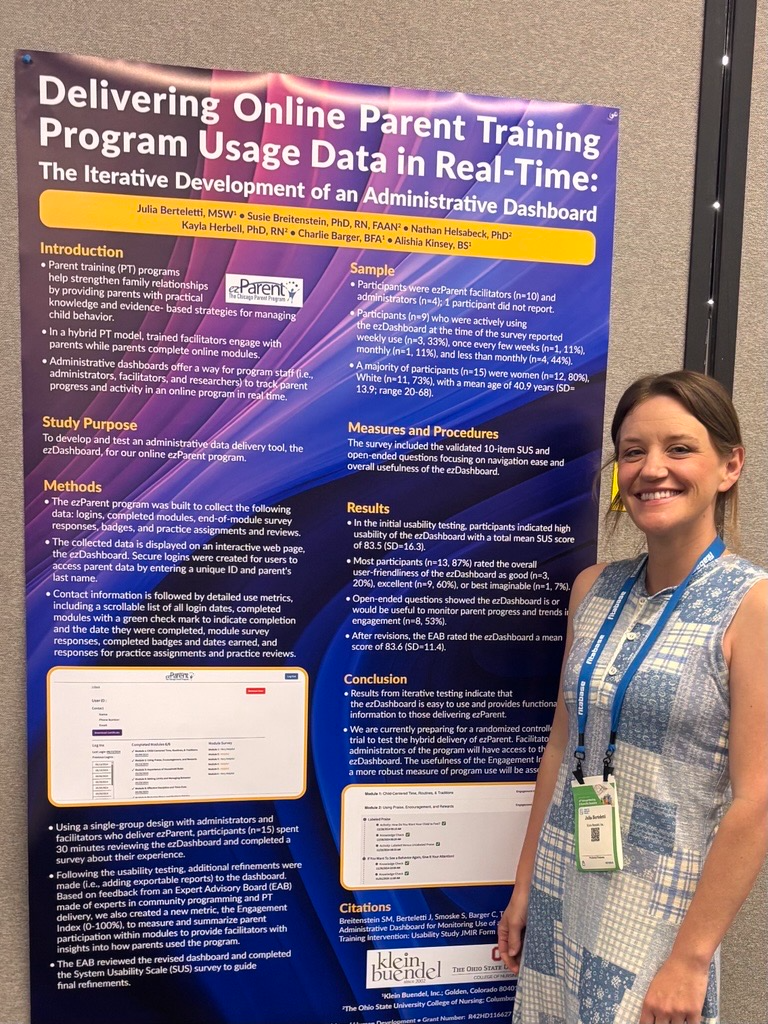
Julia Berteletti

Online parent training programs help strengthen parent-child relationships by providing parents with practical knowledge and evidence-based strategies for managing child behavior. In a hybrid parent training model, facilitators engage with parents while parents complete online modules. Administrative dashboards offer an integrated platform for program staff (administrators, facilitators, researchers) to track parent progress and activity in online parent training modules in real time. 

The research team iteratively developed and tested an administrative data delivery dashboard of the online ezParent Parent Training program. Using a single-group design with administrators and facilitators who deliver ezParent, 15 participants spent 30 minutes reviewing the ezDashboard and completed a survey about their experience. The survey included the validated 10-item System Usability Scale (SUS) and open-ended questions focusing on navigation ease and overall usefulness of the ezDashboard. Following the usability testing, we made additional refinements (adding exportable reports) to the dashboard. Based on feedback from an Expert Advisory Board (EAB) made of experts in community programming and parent training delivery, we also created a new metric, the Engagement Index, to measure and summarize parent participation within modules to provide facilitators with insights into how parents used the program. The EAB reviewed the revised dashboard and completed the SUS survey. Final refinements have been completed. 

In the initial usability testing, participants indicated high usability of the ezDashboard with a total mean SUS score of 83.5. Most participants (n=13, 87%) rated the overall user-friendliness of the ezDashboard as good (n=3, 20%), excellent (n=9, 60%), or best imaginable (n=1, 7%).  Open-ended questions showed the ezDashboard is or would be useful to monitor parent progress and trends in engagement (n=8, 53%). To facilitate that, we created the Engagement Index (0-100% per module) to assist facilitators’ understanding of how parents interact with ezParent. After revisions, the EAB rated the ezDashboard as 83.6. 

Results from iterative testing indicate that the ezDashboard is easy to use and provides functional information to those delivering ezParent.  Next, the ezDashboard will be used in a randomized controlled trial testing hybrid delivery of ezParent. The usefulness of the Engagement Index as a more robust measure of program use will be assessed.  

This STTR grant was awarded to Klein Buendel by the Eunice Kennedy Shriver National Institute of Child Health and Human Development (HD116627; Dr. Susan Breitenstein, Principal Investigator from Ohio State University). Research collaborators include Julia Berteletti from Klein Buendel, and Dr. Amie Bettencourt and Dr. Deborah Gross from Johns Hopkins University.

The ezParent technology was designed and programmed by the Creative Team at Klein Buendel. 

Experiences from the Health Chat Intervention

Experiences from the Health Chat Intervention

Dr. David Buller, Director of Research at Klein Buendel, presented experiences from the Health Chat Intervention during a symposium at the 42nd Annual (Virtual) Meeting & Scientific Sessions of the Society of Behavioral Medicine, April 12-16, 2021. Health Chat is a social media intervention for mothers and their teenage daughters designed to influence their decisions related to indoor tanning.

Despite declines in recent years, indoor tanning (IT) remains popular with some adolescent females. IT initiation can be influenced by mothers’ permissiveness toward IT and IT behavior. Social media is a popular channel with mothers for adolescent health information. Our research team developed a series of social media posts to prevent IT and evaluated their impact on mothers’ permissiveness, mothers’ and daughters’ IT attitudes, intentions, and behavior, and mothers’ support for bans on IT by minors. Investigators used an iterative method to develop theory-based social media posts, based on diffusion of innovations theory, social cognitive theory, and transportation theory of narratives.

Two innovative research techniques were employed. First, to stimulate engagement with the IT messaging, posts were embedded in a larger social media campaign on adolescent health (for example, substance abuse, diet and physical activity, and mental wellness), with 2-3 posts on IT (about 113 posts total) among the 14 health posts per week (about 710 posts total). Frequency and currency of IT posts were adjusted to avoid message fatigue and disengagement. Second, the campaign was delivered to in two Facebook private groups to create experimental separation, with control-group mother receiving posts on preventing prescription drug misuse. Recruitment was challenging with initial community-based techniques (such as schools, community groups/events, and out-calls) being largely unsuccessful.

The sample of mothers (n=869) was ultimately obtained from the Qualtrics Internet Panel from 34 states without bans IT by minors. They completed assessments at baseline and 12- and 18-months post randomization. Daughters were invited to complete baseline and follow-up assessments but just over half did so at baseline. Most mothers (87%) stayed in the private groups for the entire 12-month campaign and 277 mothers engaged with the IT posts. The effects of the IT posts in 12- and 18-months follow-ups were most evident in mothers’ reduced permissiveness and increased communication with daughters about the harms of IT. It also reduced mothers’ intentions to indoor tan. At the long-term follow-up, the campaign increased mothers’ support for bans on IT by minors and self-efficacy to refuse IT request from daughters. While there was no direct effect on mothers’ or daughters’ IT behavior, these changes may serve to prevent daughters from engaging in IT in the future. They also could help to support public policy efforts to curb further IT by minors.

This research project is funded by a grant and supplement from the National Cancer Institute (CA192652; Dr. David Buller and Dr. Sherry Pagoto, Multiple Principal Investigators).

Listen to the Health Chat presentation:

Translation of an In-Person Bystander Bullying Intervention to a Technology-Based Platform

Translation of an In-Person Bystander Bullying Intervention to a Technology-Based Platform

Klein Buendel Senior Scientist, Dr. Valerie Myers, and collaborators from Boise State University will be presenting a poster showcasing the development of a technology-based bullying prevention program during the 42nd Annual Meeting & Scientific Sessions of the Society of Behavioral Medicine from April 12-16, 2021.

Bullying is a significant problem in the United States, with more than a quarter of middle school students reporting bullying victimization. Bullying is associated with multiple mental health, social, and academic consequences. Although comprehensive school-wide interventions are available, they require significant resources for implementation, reducing access to schools, particularly in rural or low-income communities. Thus, there is a need for bullying programs that effectively address bullying while removing implementation barriers.

The STAC intervention is a brief, bystander bullying intervention that includes psychoeducation and role-plays to increase knowledge and skills to intervene in bullying. STAC stands for four strategies students can use when they witness bullying: “Stealing the show,” “Turning it over,” “Accompanying others,” and “Coaching compassion.” A series of randomized controlled trials have demonstrated the efficacy of the STAC intervention in reducing bullying perpetration and victimization, as well as depression, anxiety, and alcohol use.

The goal of the project presented in the poster was to translate the STAC program into a technology-based platform (STAC-T) for middle schools. The aims of this study were to: (1) conduct a needs assessment with middle school personnel, (2) develop a web-based prototype based on the in-person STAC intervention through iterative focus groups, and (3) conduct usability testing with middle school students and school personnel. Qualitative data from the needs assessment indicated a strong interest in a technology-based bullying intervention and positive conditions for implementation including administrative support and school technology-readiness. Students who participated in iterative focus groups reported the app concept was easily understood and engaging and identified essential features for a successful prototype.

Results from usability testing indicated participants perceived the STAC-T program to be useful and appropriate for their school and community. Findings from this study showed that the STAC-T program is relevant and feasible for implementation in the middle school settings and is usable for the target audience.

The STAC-T project is funded by an STTR grant to Klein Buendel from the National Institute on Minority Health and Health Disparities at the National Institutes of Health (MD014943; Dr. Aida Midgett, Principal Investigator). A third collaborator, in addition to Dr. Midgett and Dr. Myers, is Dr. Diana Doumas from Boise State University.

Implementation of Sun Safety Policies in Public Elementary Schools

Implementation of Sun Safety Policies in Public Elementary Schools

Klein Buendel Research Program Manager, Julia Berteletti, presented insights from a randomized controlled trial that tested a technical assistance program designed to help principals implement district sun safety policies in elementary schools at the 40th Annual Meeting and Scientific Sessions of the Society of Behavioral Medicine, March 6-9, 2019 in Washington, DC.

The Centers for Disease Control and Prevention (CDC) and U.S. Surgeon General have advised the nation’s schools to adopt and implement sun protection policy to reduce children’s exposure to solar ultraviolet radiation to prevent skin cancer. A total of 118 elementary schools from 40 California public school districts that had adopted a school board-approved policy for sun safety were recruited and the principal and a teacher at each school reported on school sun protection practices at baseline and posttest.

Half of the schools were randomly assigned to receive the 20-month Sun Safe Schools intervention, delivered by trained Sun Safety Coaches who met with principals, described the district policy, helped them select and plan implementation of sun safety practices, and provided support and resources matched to the principal’s readiness to implement practices based on Diffusion of Innovation Theory. Control schools received a minimal information treatment containing basic school sun safety information from the CDC, the National Association of State Boards of Education, and U.S. Surgeon General.

Compared to controls, principals at intervention schools reported implementing more sun safety practices in general, whether present in the district’s written policy or not. Similarly, teachers at intervention schools reported implementing a larger number of sun safety practices in general, including practices in their district’s written policy or not, compared with control schools. Overall, the intervention was effective at increasing sun safety practices in public elementary schools. However, convincing school districts to adopt policies may be only the first step in improving sun safety practices becasue districts need to actively disseminate the new policy to schools and provide assistance and materials to facilitate implementation.

This research was supported by a grant from the Eunice Kennedy Shriver National Institute for Child Health and Human Development (HD074416; Dr. Kim Reynolds, Principal Investigator). Collaborators in addition to Julia Berteletti, include Dr. Kim Reynolds and Kim Massie from Claremont Graduate University in California; Dr. David Buller and Mary Buller from Klein Buendel; Dr. Jeff Ashley from Sun Safety for Kids in, California; and Dr. Richard Meenan from Kaiser Permanente Center for Health Research in Oregon.

Using Project Management Skills in Behavioral Research

Using Project Management Skills in Behavioral Research

Research projects have various moving parts throughout their lifespan needing to be completed within a certain time frame and budget as outlined in the grant awarded. Project management skills are crucial in ensuring all phases, tasks, and logistics of a research project are organized and completed within deadline and scope.

The workload of a project is driven by how each aim breaks down into a phase, each with its own specific deliverables to be fulfilled and unique timeline to be met. As each phase of a project moves forward, the responsibilities are often compounded due to overlapping timelines, creating an increased need to think ahead and utilize efficient multi-tasking and organizational skills.

Research Project Management Phases

  • Determining and communicating the scope derived from the grant aims and methods;
  • Developing timelines;
  • Protocol development (such as recruitment, screening, data entry, intervention, data management, and adverse event processing);
  • Obtaining necessary institutional approvals;
  • Staff identification/hiring, training, and evaluation;
  • Goal setting including incremental goals as well as larger overarching goals;
  • Project implementation;
  • Delivering objectives including communication of progress toward objectives;
  • Tracking budgeted and expended costs;
  • Required reporting to aid in communicating progress; and
  • Problem-solving as issues inevitably arise.

Communication is a key component to ensuring a smooth flow of the deliverables throughout the project. All personnel on a project need to maintain the same vision and goals. This can often be accomplished using regular meetings, phone calls, emails, and reports. Beyond the regular means of communication, a more comprehensive system such as project management software can be used to keep track of deliverables and deadlines.

Klein Buendel Research Program Manager, Julia Berteletti, organized and participated in a research project management Pre-Conference Workshop at the 40th Annual Meeting and Scientific Sessions of the Society of Behavioral Medicine (SBM), March 6-9, 2019 in Washington, DC. Co-presenters included Jessica Bibeau and Jared Goetz from the University of Connecticut, and Kim Massie from Chapman University in California. The presenters have been coordinating multi-site research projects from coast-to-coast with each other for several years. Ms. Berteletti explained, “Our projects run on effective partnerships. Facilitating teamwork is one of my favorite parts of my job. It meant a lot to me for us to share our methods for effective collaboration and project management with other research teams.”

The SBM seminar provided a guide for managing a research project using a project management approach which included: (a) understanding the scope, (b) setting goals, (c) considering the costs, (d) implementation (intervention/data collection), and (e) close-out. A hypothetical project was used to present each part of the approach. Team organization, communication, important considerations, timelines, charts, and reports were reviewed to aid in organization, and project management software ideas were provided along with a tutorial of the Basecamp software.